The Nigerian Railway Corporation (NRC) has confirmed that 26 passengers and crew members sustained injuries following a train incident along the Abuja–Kaduna rail corridor on Monday.
In a statement shared on Tuesday, the NRC Managing Director, Kayode Opeifa, said the incident occurred at about 9:16 a.m. near Asham Station when a loud bang was heard during the journey.
According to him, the Kaduna–Abuja service (KA-2) departed Rigassa Station at 7:15 a.m. and arrived at Jere Station slightly ahead of schedule before continuing its trip.
He explained that the train had left Jere at 8:59 a.m., after a brief delay caused by the coupling of an additional locomotive to strengthen the formation.
The incident reportedly happened between kilometre points 50 and 51 as the train approached Asham Station.
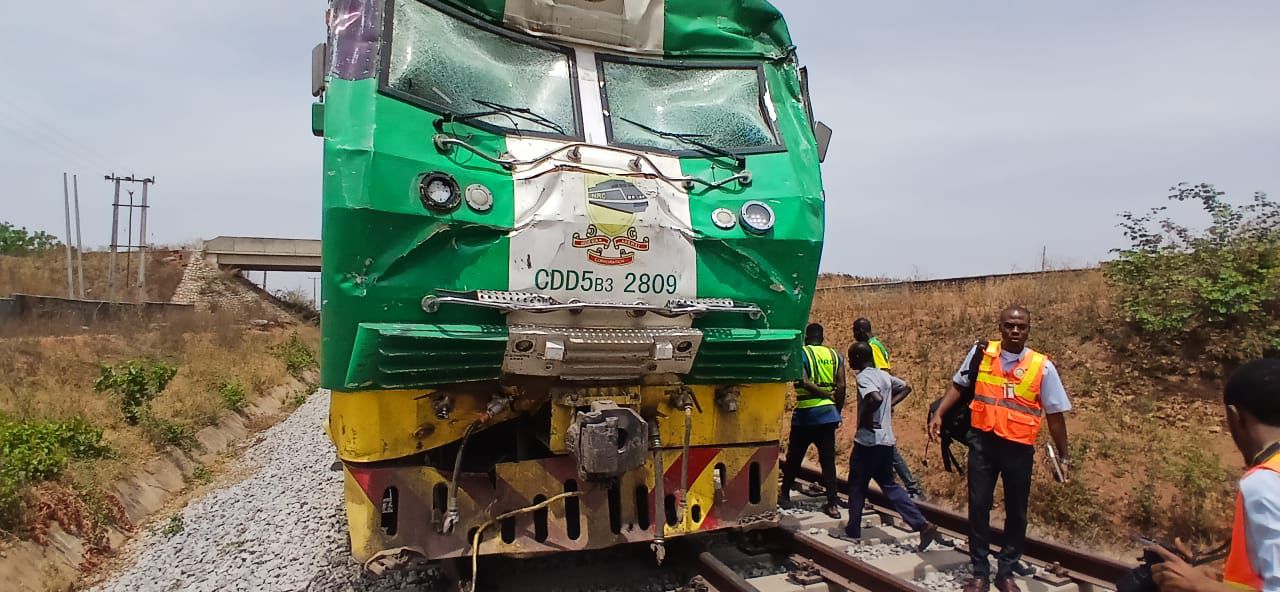
“At about 9:16 a.m., a loud bang was heard as the power car and trailing locomotive collided with one of the coaches. Preliminary findings point to a possible issue with one or more couplers,” Opeifa said.
He noted that no coach derailed, although the exact cause of the suspected decoupling is still under investigation.
Following the incident, the affected components — including locomotive 2809, power car BVA0002, and passenger coach SP0006 — were detached before the train continued its journey.
Read Also;
Train Collision on Abuja-Kaduna Line Leaves Passengers Injured
Despite the disruption, the train resumed movement at 9:42 a.m., arriving Kubwa at 10:10 a.m. and reaching its final destination, Idu Station, at 10:39 a.m., recording a total delay of 38 minutes.
Providing further details, Opeifa disclosed that 481 people were on board at the time, including 429 passengers, 10 crew members, 26 security personnel, six food vendors, eight cleaners and two third-party operators.
“A total of 26 individuals sustained varying degrees of injuries,” he said, noting that those affected included passengers as well as onboard staff.
The NRC boss added that services were later restored, with subsequent trips on the route operating, though behind schedule, as efforts were made to stabilise operations after the incident.