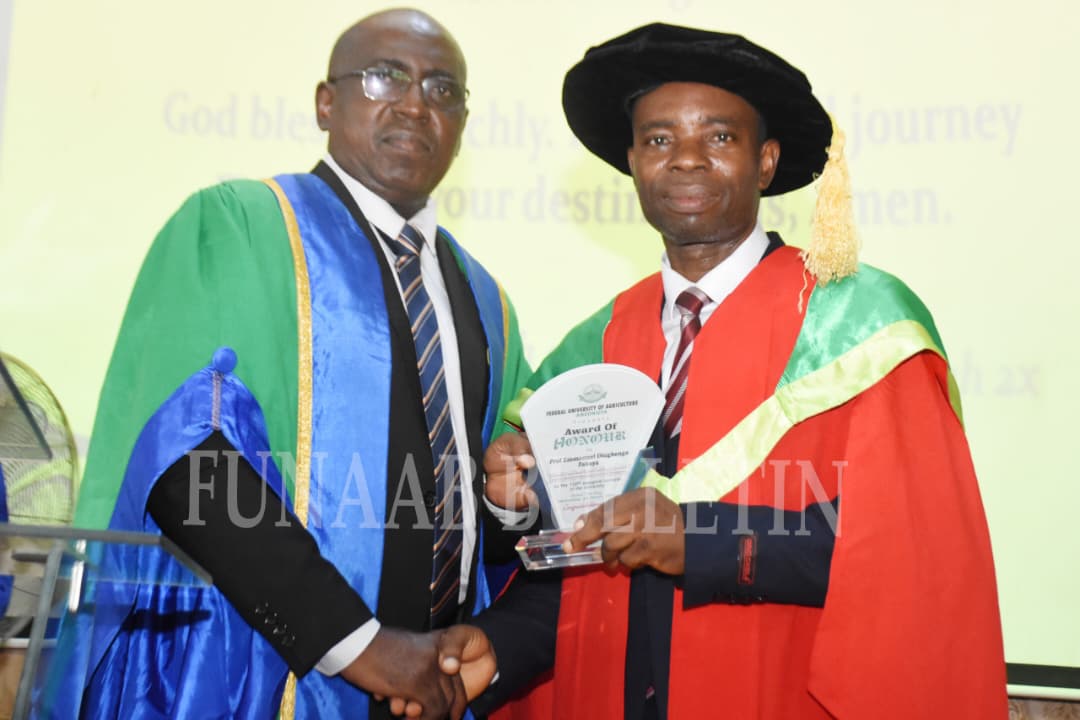
A professor at Federal University of Agriculture Abeokuta, Emmanuel Fakoya, has announced the creation of a ₦1 million annual prize to reward the university’s best student in the Farm Practical Year programme.
The professor, who specialises in Agricultural Extension and Rural Development, said the award was established in honour of his late father, Samuel Fakoya.
He made the announcement while delivering the institution’s 110th inaugural lecture titled “Measurement and Scaling: Bedrock of Robust Agricultural Extension Research Analysis.” The lecture took place at the Prof. Oluwafemi Balogun Ceremonial Building.
Fakoya, who also serves as the Dean of the College of Agricultural Management and Rural Development, explained that the prize will run for 10 years and will begin from the university’s 34th convocation ceremony.
According to him, the initiative is aimed at encouraging excellence in practical agricultural training and motivating students to perform better during the university’s Farm Practical Year programme.
“I am instituting this ₦1 million annual prize for the university’s best student in farm practical in honour of my late father. It is meant to promote excellence in hands-on agricultural training and encourage outstanding performance among students,” he said.
During the lecture, Fakoya also called for a major shift in the way agricultural policies are developed in Nigeria. He stressed that policies should be based on strong empirical evidence rather than assumptions or anecdotal reports.
He noted that important areas such as land management, livestock production, conflict resolution, and women’s empowerment continue to face challenges because of the lack of standardised measurement systems.
According to him, without reliable data and proper measurement tools, it becomes difficult to accurately assess the real impact of agricultural extension programmes on rural communities.
The professor emphasised that participation, access to resources, and empowerment must be measured using reliable indicators to ensure that agricultural interventions remain inclusive and gender-sensitive.
Fakoya also recommended greater collaboration among experts, including agricultural economists, sociologists, statisticians, and extension specialists. He suggested that universities and research institutions should establish specialised centres dedicated to measurement and scaling studies to improve research methods in the agricultural sector.
Read Also;
Civilians Feared Dead as Terrorists Attack Military Base in Borno
He further highlighted the importance of modern quantitative tools such as Likert scaling, factor analysis, and regression modelling, noting that they can help improve the accuracy of agricultural research and policy planning.
In his remarks, the Vice-Chancellor of Federal University of Agriculture Abeokuta, Babatunde Kehinde, praised Fakoya for his contributions to academic research.
Kehinde described the lecture as timely and impactful, adding that strengthening research methods and ensuring reliable data are essential for advancing Nigeria’s agricultural development.