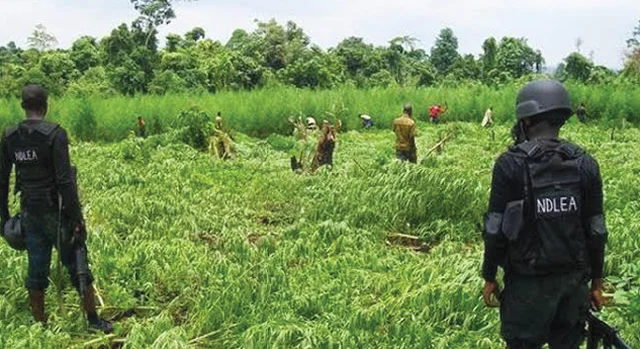
The National Drug Law Enforcement Agency (NDLEA) has stepped up efforts to curb illicit cannabis cultivation by introducing an alternative development programme designed to replace illegal farming with lawful and sustainable means of livelihood for rural communities.
Speaking with journalists in Abuja on Tuesday, the Chairman and Chief Executive Officer of the NDLEA, Brig. Gen. Buba Marwa (retd.), called for strong national backing and sustained support for the initiative, describing it as the first of its kind on the African continent.
Marwa disclosed that the pilot phase of the programme was launched last week in three known cannabis-producing communities—Ilu Abo, Ifon and Eleyewo in Ondo State. He explained that the initiative goes beyond simply replacing cannabis with other crops, as it is targeted at addressing the underlying causes of illegal drug cultivation.
According to him, the alternative development approach focuses on strengthening rural economies through agricultural value-chain development, promoting peace and social cohesion in crime-prone areas, boosting food production and diversification, and reducing pressure on law enforcement and the justice system.
“The concept goes far beyond crop substitution,” Marwa said. “Its wider benefits include strengthening rural economies, reducing the burden on law enforcement and the justice system, promoting peace and social cohesion, supporting national food production and improving Nigeria’s international standing in global drug control and development cooperation.
“This approach represents a win-win solution for communities, government and national security. The successful take-off of the pilot scheme in Ondo State clearly shows that alternative development works when communities are engaged, supported and empowered.”
He called on all stakeholders—including federal, state and local governments, traditional rulers, community leaders, development partners, donor agencies, the private sector, civil society organisations and the media—to support the programme and ensure its sustainability.
Marwa also urged communities affected by illicit drug cultivation to embrace the initiative, stressing that it was designed with their welfare in mind.
“The alternative development programme is not just a drug control initiative; it is a people-centred development intervention aimed at uplifting communities, strengthening national security and securing Nigeria’s future,” he said.
The NDLEA boss revealed that over 75 per cent of the 15 million kilograms of illicit drugs seized by the agency in the past five years were cannabis, warning that enforcement alone would not solve the problem.
“Cannabis is not a marginal issue in Nigeria. It is the most widely used and readily available illicit drug in the country,” he said. “An estimated 10.6 million adults—more than one in every ten Nigerians—used cannabis in the past year.
“The social and public health implications are serious, ranging from long-term health challenges and dependency to crime, lost productivity and pressure on an already overstretched healthcare system.”
Marwa added that the sheer volume of cannabis seized in recent years underscored the scale of the problem, noting that such quantities, if left unchecked, could have caused immense harm to youths, public health and national security.
Read Also;
Three-Month Health Workers’ Strike Grounds Services, Leaves Patients Stranded Nationwide
Expressing optimism, he said the alternative development initiative could reverse the trend if it received sustained national support, adding that the NDLEA was committed to expanding the programme nationwide in collaboration with local and international partners.
On the Ondo pilot scheme, Marwa said host communities and their leaders had welcomed the programme, describing it as a dignified and legal source of income capable of reducing poverty, improving food security and enhancing stability.
He noted that the agency adopted the strategy after recognising the scale of cannabis cultivation in Nigeria, citing findings from the 2018 National Drug Use Survey, which identified cannabis as the most widely used and cultivated illicit drug in the country.
Despite years of enforcement operations, Marwa said illicit cannabis cultivation—driven by rural poverty, criminal networks and insecurity—remains a major challenge, making alternative development a necessary and timely intervention.