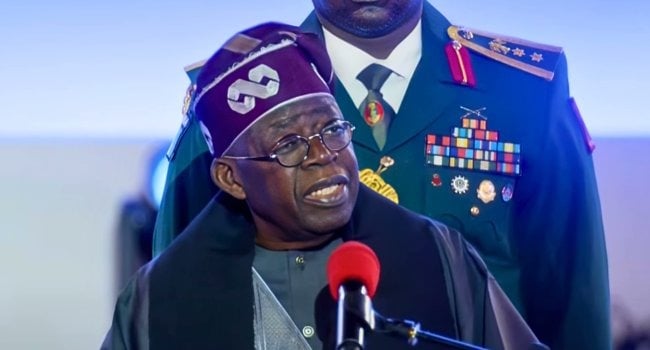
President Bola Tinubu has mandated the National Institute for Policy and Strategic Studies (NIPSS) to conduct a comprehensive security assessment across the country and submit clear, actionable recommendations to support ongoing reforms in Nigeria’s security architecture.
The directive was delivered on Wednesday during a Presidential Parley with participants of Senior Executive Course 47 at the State House, Abuja. Vice President Kashim Shettima represented the President at the event.
According to a statement by the VP’s Senior Special Assistant on Media and Communication, Stanley Nkwocha, the President paired the security assignment with a renewed focus on developing Nigeria’s blue economy—one he described as a core engine for national transformation.
Tinubu praised NIPSS for its role as “the intellectual engine of our national transformation”, assuring the scholars that their policy document would receive full attention once submitted.
Focus on the Blue Economy
The President said the blue economy—Nigeria’s vast marine and aquatic resources—holds the potential to diversify revenue, create sustainable jobs, and strengthen key sectors including tourism, fisheries, transport, and renewable energy.
He emphasised that Nigeria’s coastline, rich fisheries, inland waterways, and strategic position in the Gulf of Guinea place the country in a strong position for economic expansion.
“We are prioritising aquaculture expansion, maritime corridor upgrades, coastal tourism development, marine biotechnology and renewable ocean energy,” he said.
Tinubu noted that the creation of the Ministry of Marine and Blue Economy was a major step to modernise port management, strengthen maritime security, and attract private investment.
However, he acknowledged that challenges such as oil theft, illegal fishing, smuggling, vandalism, and kidnapping still pose threats to growth and investor confidence.
Security and Stability Still a Priority
While the Deep Blue Project has reduced piracy, the President insisted that economic progress cannot thrive without a secure environment. He tasked NIPSS with helping to identify systemic gaps and offer a clear roadmap for strengthening national security.
NIPSS Presents Blue Economy Findings
Earlier, NIPSS Director-General Prof. Ayo Omotayo thanked the President for the continuous support and highlighted the team’s extensive work across several states and 14 countries.
Presenting the report titled “Blue Economy and Sustainable Development in Nigeria: Issues, Challenges and Opportunities,” Colonel Murkar Dauda said Nigeria needed better coordination, improved infrastructure, and harmonised policies to fully unlock the blue economy’s potential.
Read Also;
ECOWAS Moves to Scrap Air Ticket Taxes by 2026
Governors Applaud Tinubu for Swift Action Against Benin Coup Attempt
The report recommended:
Launching a national fisheries expansion programme to grow fish production from 1.2 million tonnes to 10 million tonnes within two years
Expanding revenue sources within the marine economy
Harmonising all legaland policy frameworks relating to the blue economy
Improving safety on inland waterways
Developing a skills and job-creation framework tailored to the marine sector
Dauda commended the President for his commitment to moving the economy forward and addressing long-standing gaps in governance and maritime development.
Overall, the President’s new directive signals a renewed push for stronger security and economic diversification, with the blue economy positioned as a key pillar for Nigeria’s long-term prosperity.