United States lawmakers on Tuesday held a joint briefing in Washington DC to address the rising cases of kidnappings and the alleged persecution of Christians in Nigeria.
The briefing followed a directive issued on October 31 by President Donald Trump, asking the House Appropriations Committee to investigate what he described as the “slaughter of Christians” in Nigeria and provide a detailed report to the White House.
Meanwhile, the Nigerian House of Representatives is also expected to debate the country’s worsening security situation today (Wednesday).
The session was led by House Appropriations Vice Chair and National Security Subcommittee Chairman, Mario Díaz-Balart. Members of the House Appropriations and House Foreign Affairs Committees attended the meeting, alongside experts on international religious freedom.
Some participants included Reps Robert Aderholt, Riley Moore, Brian Mast, Chris Smith, USCIRF Chair Vicky Hartzler, ADF International’s Sean Nelson, and Dr Ebenezer Obadare of the Council on Foreign Relations.
Díaz-Balart described global religious liberty as both a moral duty and a key American priority, stressing that no one should be targeted because of their faith. He noted that the FY26 funding bill reflects this commitment and promised further action when Congress passes a full-year funding measure.
Aderholt described the situation in Nigeria as “a crisis that can’t be ignored,” adding that lawmakers must stand with persecuted Christians. Moore connected the issue to the recent redesignation of Nigeria as a “Country of Particular Concern” by the US government.
Foreign Affairs Committee Chairman Mast went further, calling the attacks on Christians “a targeted campaign of religious cleansing,” while urging the Nigerian government to act decisively.
In his remarks, Africa Subcommittee Chairman Chris Smith described Nigeria as “the ground zero of religious violence,” accusing the government of allowing perpetrators to operate freely.
Expert witnesses also painted a grim picture.
Hartzler referenced several recent attacks, including the abduction of more than 300 children and teachers from a Catholic school in November. She criticised the lack of timely response from security forces despite early warnings.
Sean Nelson presented stories of kidnappings, forced conversions, and violent attacks on Christian communities. He also highlighted cases of unjust imprisonment and the existence of blasphemy laws that can carry the death penalty in some states.
Obadare identified Boko Haram as the major driver of religious violence, urging the US to maintain pressure on Nigeria. He suggested two main goals: supporting the Nigerian military to defeat Boko Haram, and pushing for Sharia law to be declared unconstitutional in the 12 Northern states that adopted it.
Committee officials confirmed that a full report will be submitted to President Trump, containing recommendations on how Congress can support efforts to curb religious persecution.
This comes as US–Nigeria security cooperation intensifies. Tinubu recently approved the formation of the US–Nigeria Joint Working Group to strengthen counterterrorism operations, enhance intelligence sharing, and boost humanitarian response.
On November 20, the US House Subcommittee on Africa held a public hearing to review Trump’s redesignation of Nigeria as a Country of Particular Concern—an action that could potentially lead to sanctions on officials linked to religious persecution.
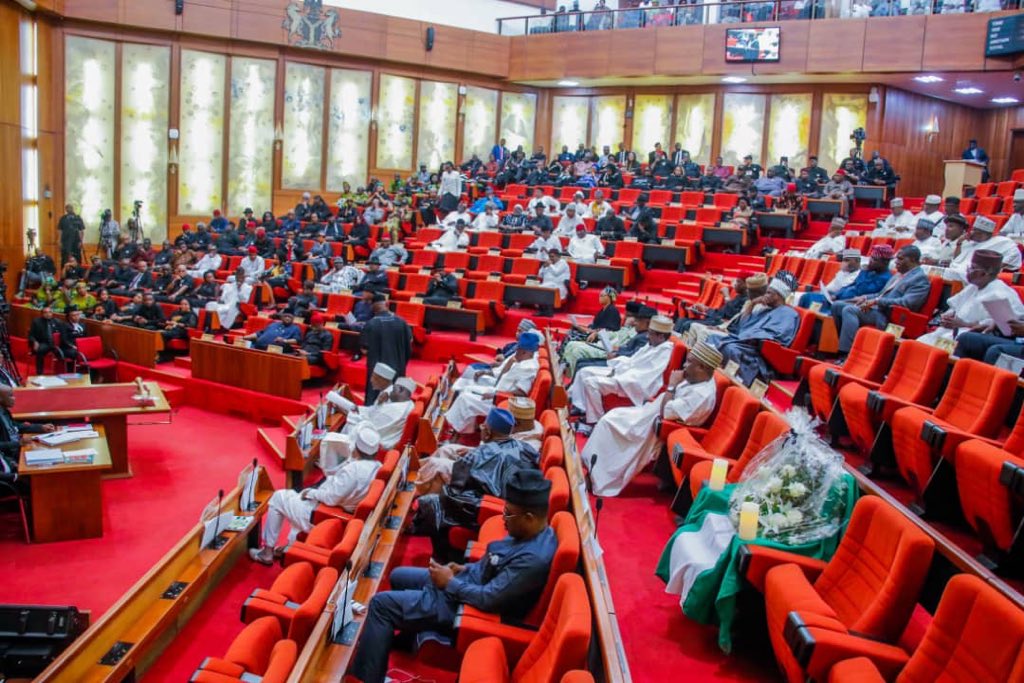
Back home, Nigeria’s House of Representatives will today begin debates on the deteriorating security situation. Deputy Speaker Benjamin Kalu confirmed the session during Tuesday’s plenary.
Separately, a report on the state police bill is expected to be laid before the House this month, according to Mansur Soro of Bauchi State. He stated that state assemblies have been asked to submit their positions on several constitutional amendment items, including state police, devolution of powers, and fiscal federalism.
Lawmakers Marcus Onobun and Bamidele Salam also expressed strong support for state policing, arguing that the current centralised police structure cannot effectively tackle Nigeria’s deeply localised security problems.
Read Also;
Senate Moves to Establish a Single National Emergency Number
Tinubu Meets Security Chiefs in Urgent Closed-Door Briefing
Tinubu Meets Service Chiefs
Meanwhile, President Bola Tinubu held a closed-door meeting on Tuesday with Service Chiefs and heads of security agencies at the Presidential Villa, Abuja.
The meeting came barely three hours after the nomination of former Chief of Defence Staff, Gen. Christopher Musa (retd.), as the new Minister of Defence—following the resignation of Abubakar Badaru on Monday night.
Present at the meeting were the Chief of Defence Staff, General Olufemi Oluyede; Chief of Army Staff, Lt. General W. Shaibu; Chief of Air Staff, Air Vice Marshal Sunday Aneke; Chief of Naval Staff, Vice Admiral I. Abbas; the Chief of Defence Intelligence, Lt. General Akomaye Undiandeye; DSS Director-General, Oluwatosin Ajayi; and Inspector-General of Police, Kayode Egbetokun.
Last Wednesday, Tinubu declared a nationwide security emergency after a surge in kidnappings and announced measures such as recruiting 20,000 new police officers, deploying forest guards, and boosting protection for schools and worship centres.
Abia State Governor, Dr Alex Otti, was also seen arriving at the Villa, carrying a file, though it was unclear whether he joined the security meeting.