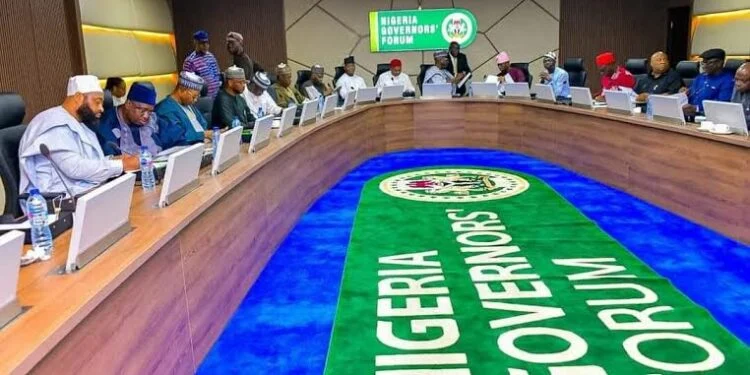
Despite receiving close to ₦9 trillion from Federation Account Allocation Committee (FAAC) inflows in 2025, state governments across Nigeria are under growing fire from labour unions, civil society groups, economists and opposition parties over what critics describe as little improvement in the living conditions of citizens.
FAAC disbursement figures show that allocations to states rose sharply in 2025, increasing by more than ₦2 trillion compared to the previous year. Data indicate that states received about ₦7.315 trillion directly from FAAC in 2025, up from ₦5.186 trillion in 2024 — a year-on-year jump of roughly 41 per cent. When the constitutionally mandated 13 per cent derivation revenue is added, total inflows to states climbed to approximately ₦8.934 trillion, nearly ₦9 trillion, representing a 36.7 per cent increase.
This surge has reignited debate over governance at the subnational level. Organised labour, led by the Nigeria Labour Congress (NLC), argues that the increased revenue has not translated into better welfare for ordinary Nigerians. The union blames weak governance, corruption and misplaced priorities by state governments.
Civil society organisations echo similar concerns, accusing governors of mismanaging the windfall and failing to convert higher revenues into tangible development such as improved healthcare, education, infrastructure and social services. Many advocates are now calling for stronger transparency, monitoring and accountability mechanisms around FAAC spending.
Economists acknowledge that the higher allocations have eased short-term liquidity pressures on states, particularly those struggling with salary obligations and debt servicing. However, they warn that excessive reliance on federal allocations continues to undermine sustainable development, as many states neglect efforts to grow internally generated revenue (IGR).
A closer look at the data shows that total FAAC disbursements to all tiers of government rose from ₦15.259 trillion in 2024 to ₦21.897 trillion in 2025. While states received a substantial share of this increase, their relative portion declined slightly as allocations to the Federal Government and local governments also expanded.
Monthly allocations to states improved steadily throughout 2025, peaking at over ₦727 billion in October, compared with far lower monthly figures in 2024. By mid-year, states had already received more than ₦3.32 trillion, significantly easing cash flow pressures.
Derivation revenue also rose strongly, with oil-producing states sharing about ₦1.619 trillion in 2025, up over ₦270 billion from the previous year. Despite this, critics argue that the visible impact on citizens’ welfare remains minimal in many states.
Findings from the BudgIT State of States Report reveal that more than 30 states depend heavily on FAAC for survival, with many relying on federal allocations for over 60 per cent — and in some cases over 80 per cent — of their recurrent revenue. The report warns that rising FAAC inflows may be discouraging states from developing sustainable local revenue sources, noting a decline in the share of IGR within total recurrent revenue.
Experts have also cautioned that FAAC revenues are volatile and largely tied to oil prices, leaving state budgets vulnerable to external shocks. Some economists have proposed incentive-based systems, such as rewarding states that improve IGR performance, to reduce overdependence on Abuja.
Read Also;
FG, States, LGs Share ₦1.969trn December 2025 FAAC Revenue
Labour unions insist that without consequences for mismanagement, increased allocations will continue to enrich political elites rather than improve public welfare. “Very few states are deploying these funds effectively,” an NLC official said, warning that corruption continues to erode development outcomes.
Across the country, opposition parties have voiced similar frustrations. From Lagos to Sokoto, Bauchi to Zamfara, critics argue that rising allocations have not eased hardship, pointing to poor schools, weak healthcare systems, rising rents, unemployment and insecurity. Some parties accuse state governments of prioritising beautification projects, political positioning and preparations for future elections over real development.
However, not all assessments are negative. In a few states, opposition figures have acknowledged visible infrastructure projects and better fiscal discipline, citing roads, flyovers, healthcare facilities and education investments as evidence of progress.
Still, the broader consensus among critics is clear: while FAAC inflows to states are at historic highs, many Nigerians are yet to feel the impact. As debates continue, pressure is mounting on governors to show clearly how trillions received in 2025 are improving lives beyond balance sheets and budget speeches.