
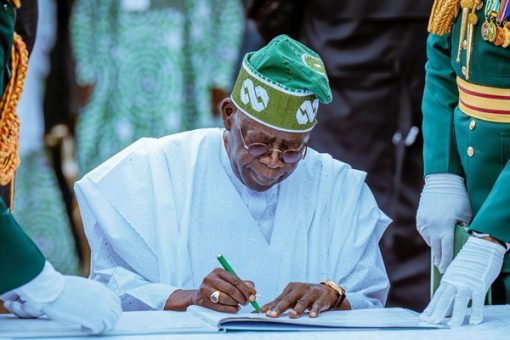
President Bola Tinubu has signed the Electoral Act 2026 (Amendment) into law, sparking strong reactions from opposition parties and civil society groups who fear the new provisions could weaken Nigeria’s electoral process ahead of the 2027 general elections.
Tinubu signed the bill on Wednesday evening at the Presidential Villa in Abuja, barely 24 hours after it was passed by both chambers of the National Assembly. The signing ceremony was attended by senior lawmakers and government officials.
However, the development has drawn sharp criticism, with opposition parties describing the move as a major setback for Nigeria’s democracy.
PDP calls it “dark day for democracy”
The Peoples Democratic Party (PDP) condemned the President’s swift assent, accusing the ruling All Progressives Congress (APC) of rushing the law out of fear of losing the 2027 elections.
In a statement, the party described the decision as “a dark day for democracy,” claiming the amendment could legalise electoral manipulation.
The PDP said the President failed to rise above party interests, insisting that Nigerians deserved a stronger law that guarantees transparent elections.
Civil society groups warn of possible manipulation
Several civil society organisations also expressed disappointment, particularly over the failure to make real-time electronic transmission of results mandatory.
Executive Director of YIAGA Africa, Samson Itodo, described the law as a missed opportunity for true reform, saying it does not address key gaps needed to strengthen elections.
Similarly, Accountability Lab’s Country Director, Friday Odeh, warned that the amendment could open doors for rigging and reverse progress made in recent years.
However, the Executive Director of CISLAC, Auwal Musa, urged Nigerians to accept the law for now while continuing advocacy for improved reforms in the future.
Labour Party lawmakers protest
The Labour Party caucus in the House of Representatives also criticised the President’s quick assent, describing it as suspicious and rushed.
The caucus leader, Afam Ogene, questioned whether the Presidency had enough time to properly review the bill before signing it into law.
He said the new law ignored the concerns of Nigerians and promised that the opposition would mobilise citizens to resist any attempt to compromise electoral integrity.
CUPP slams Tinubu, N’Assembly
The Coalition of United Political Parties (CUPP) also faulted Tinubu and the National Assembly, accusing them of undermining Nigerians by retaining provisions that allow manual transmission of results when electronic transmission fails.
According to CUPP, Nigerians demanded mandatory electronic transmission, and anything short of that creates room for manipulation.
Tinubu raises concerns over broadband capacity
While signing the bill, Tinubu defended his decision, raising concerns about Nigeria’s broadband strength and the country’s ability to support real-time electronic transmission nationwide.
He argued that even the best system can still be compromised if not properly managed by humans, noting that voting and result collation at polling units are still done manually.
Akpabio says law will make votes count
Senate President Godswill Akpabio, however, said the amended law would improve transparency and reduce manipulation.
He explained that polling unit results will now be transmitted electronically to INEC’s portal, but manual records—especially the EC8A form signed at polling units—will remain the primary reference, particularly in areas with poor network coverage.
Akpabio said this will allow Nigerians to compare uploaded results with final collation figures, making it harder to alter outcomes.
Other key changes
The Speaker of the House of Representatives, Abbas Tajudeen, said the amendment also reduced the election notice period from 360 days to 300 days, which could push the 2027 elections earlier and help avoid voter apathy during Ramadan.
The law also introduces provisions supporting direct primaries and mandates fresh elections where winners are disqualified, instead of automatically declaring the runner-up.
Read Also;
Thugs Storm APC Secretariat in Ondo, Party Chairman and Others Beaten
Wike praises Tinubu
Meanwhile, Minister of the Federal Capital Territory, Nyesom Wike, praised Tinubu for signing the bill quickly, describing it as a sign of commitment to strengthening Nigeria’s democracy.
He said the move would silence those planning protests and excuses ahead of the 2027 elections.
The signing of the amended Electoral Act comes shortly after INEC released the official timetable for the 2027 general elections, with presidential and National Assembly polls scheduled for February 20, 2027, and governorship and state assembly elections fixed for March 6, 2027.