
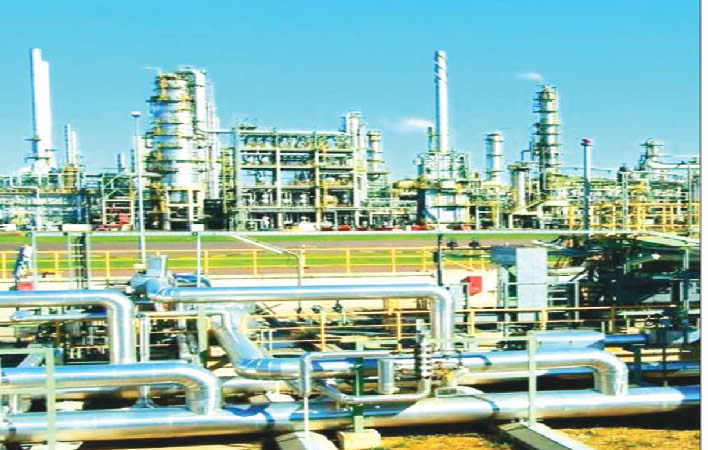
The Nigerian National Petroleum Company Limited has told the Federal High Court in Lagos that petroleum products from Dangote Petroleum Refinery and Petrochemicals FZE are sold at “significantly high and fluctuating market prices,” warning that granting the refinery’s requests could hand it monopoly control of Nigeria’s downstream petroleum sector.
The national oil company made the argument in a counter-affidavit filed in response to Dangote refinery’s suit before the Federal High Court, Lagos Judicial Division.
Marketers under the Petroleum Products Retail Outlet Owners Association of Nigeria also backed the NNPC’s position, insisting that competition must remain in the sector to prevent price exploitation and ensure multiple supply sources capable of reducing fuel prices.
Dangote refinery had challenged the issuance of petrol import licences to marketers and the NNPC by the Nigerian Midstream and Downstream Petroleum Regulatory Authority.
The refinery argued that the continued approval of petrol imports violated existing regulations and undermined local refining capacity, despite claims that it now supplies more than 90 per cent of Nigeria’s daily petrol consumption.
In the suit, Dangote accused the NNPC and regulatory agencies of frustrating its operations by denying it adequate crude oil supplies while encouraging fuel importation despite its refining capacity.
However, the NNPC asked the court to dismiss the suit, describing it as premature and incompetent.
“The plaintiff’s petroleum products are already sold at significantly high and fluctuating market prices dictated by its commercial interests,” the NNPC stated in its affidavit.
The company further accused the refinery of attempting to dominate the downstream petroleum market and edge out other operators.
“The reliefs sought by the plaintiff are aimed at substantially restricting or eliminating other participants within the petroleum importation and supply chain,” the company argued.
According to the NNPC, granting the refinery’s requests would expose Nigeria’s petroleum sector to monopoly control and undermine competitive participation in the industry.
The company warned that depending solely on one supplier for national fuel needs could threaten the country’s energy security.
“Restricting importation channels in the manner sought by the plaintiff would expose Nigeria to severe risks of petroleum shortages, supply disruptions, price instability, distribution failures, and national energy crises,” the affidavit stated.
The NNPC maintained that Dangote refinery had not provided independently verified evidence proving it could consistently meet the country’s daily fuel demand or guarantee uninterrupted nationwide supply.
“There is no credible, independent, or verifiable evidence before this Honourable Court establishing that the plaintiff presently satisfies the petroleum product demands of Nigeria,” the company said.
It also noted that fuel supply obligations involve more than refining capacity alone, including logistics, transportation, strategic storage, distribution, evacuation, and reserve management.
The company defended the continued issuance of import licences by regulators, insisting that such approvals were lawful and necessary for market stability and national energy security under the Petroleum Industry Act.
According to the NNPC, Section 317(8) of the Petroleum Industry Act only gives regulators discretionary powers regarding backward integration policy and does not impose a ban on petroleum imports.
The oil company also denied allegations that it deliberately sabotaged the refinery or withheld crude oil supplies.
“Contrary to the plaintiff’s allegations, the 2nd Defendant has not sabotaged the plaintiff’s refinery operations,” it stated.
The NNPC said crude oil supply arrangements were affected by operational realities, security considerations, contractual obligations, logistics, and production levels.
Read Also:
NNPC, NUPRC Remit Over N322bn, $116m to Federation Account After Tinubu’s Executive Order
Meanwhile, PETROAN President Billy Gillis-Harry supported the position of the NNPC, saying competition in the downstream sector remains essential for product availability, price moderation, efficiency, and sustainability.
He warned against creating a monopoly in the petroleum industry, stressing that Nigeria’s downstream market must remain open and competitive.
“One of the benefits of healthy competition in the downstream petroleum sector is the reduction in fuel prices through competitive pricing,” he said.
Gillis-Harry added that monopoly could lead to arbitrary pricing, reduced efficiency, and limited options for consumers.
On the other hand, the Crude Oil Refineries Association of Nigeria defended local refiners, arguing that refinery investors had demonstrated stronger long-term commitment to Nigeria’s petroleum sector than importers.
The association stated that local refiners had invested heavily in fixed industrial assets despite risks associated with crude supply, foreign exchange volatility, logistics, and regulatory uncertainty.
The legal battle marks another major confrontation between Dangote refinery and government oil agencies following the deregulation of Nigeria’s downstream petroleum sector and the removal of petrol subsidy in 2023.