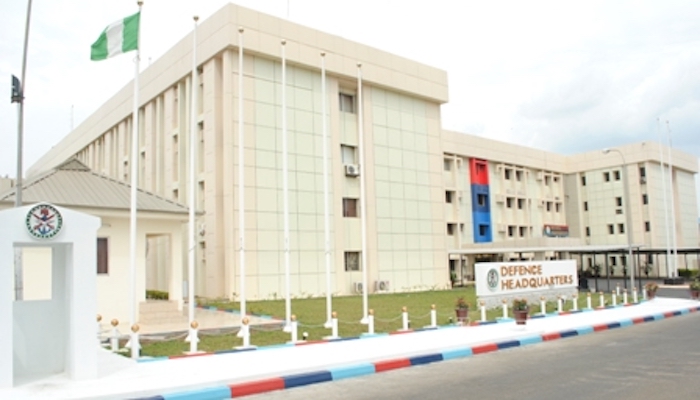
One of the military officers standing trial over an alleged plot to overthrow the government of President Bola Tinubu has challenged the authority of the Defence Headquarters Garrison General Court Martial in Abuja to hear the case.
The second accused person, Col. Mohammed Ma’aji, filed a preliminary objection before the military tribunal sitting in Asokoro, arguing that the court lacks the legal jurisdiction to try him on charges related to alleged mutiny and conspiracy.
Ma’aji is among 36 persons facing charges before the court martial in a case filed by the Armed Forces of Nigeria.
In his objection, the officer asked the tribunal to strike out all charges against him, insisting that the case was fundamentally defective and legally incompetent.
According to the filing, brought under the Rules of Procedure Army 1972, Ma’aji argued that the Armed Forces of Nigeria, listed as the complainant in the case, is not a legally recognised entity capable of instituting criminal proceedings.
“The complainant, Armed Forces of Nigeria, is not a juristic person and therefore lacks the competence to initiate and prosecute the case,” the objection stated.
The defence further argued that because the complainant allegedly lacks legal personality, the General Court Martial equally lacks jurisdiction to hear the matter.
Ma’aji also challenged counts one to nine of the charge, which accused him of allegedly inciting officers to join a plot to overthrow the government.
According to him, the allegations contained in the charge do not amount to mutiny as defined under the Armed Forces Act.
He maintained that the accusations relate more to offences against the Nigerian state and constitutional order rather than military insubordination or rebellion against lawful military authority.
The officer argued that the phrase “plot to overthrow the government of the Federal Republic of Nigeria” could not automatically be interpreted as mutiny under military law.
Relying on previous Supreme Court decisions, Ma’aji insisted that penal laws must be interpreted strictly in favour of the accused.
He also argued that for mutiny charges to stand, the prosecution must show evidence of organised military rebellion, refusal of lawful commands, or coordinated insubordination — elements he claimed were absent from the charges filed against him.
The court is yet to rule on the objection.
Meanwhile, proceedings also continued before the Federal High Court in Abuja in the separate trial of six alleged coup plotters linked to the same investigation.
During Wednesday’s sitting before Justice Joyce Abdulmalik, a video statement by one of the defendants, Zekeri Umoru, was played in court.
In the video, Umoru alleged that Col. Ma’aji discussed plans to force entry into the Presidential Villa, even if security insiders refused to cooperate.
Read Also:
APC Governorship Primaries Heat Up as Consensus Push Triggers Tension Across States
According to the witness, Ma’aji allegedly sought help in recruiting individuals working inside the Villa, including soldiers, DSS personnel and staff linked to construction projects within the complex.
Umoru further claimed that discussions were held about disrupting electricity supply inside the Presidential Villa to aid the alleged operation.
He alleged that an attempt was made to negotiate access through an ambulance route, but disagreements later emerged over the amount of money demanded to facilitate entry.
The witness told investigators that he eventually became uncomfortable with the alleged plan and attempted to distance himself from it.
Following the presentation of the video evidence, the court adjourned the matter until May 21 for continuation of the trial-within-trial proceedings.