By Evans Ufeli Esq
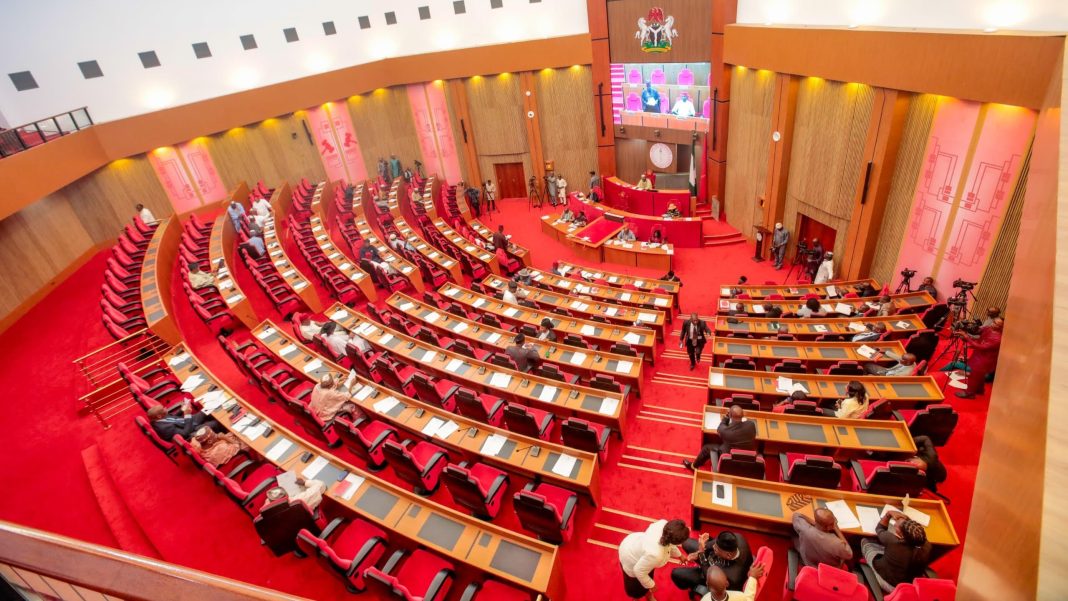
A new dawn breaks over Nigeria’s constitutional landscape and, as light dapples through the canopy after a long, restless night, so too do the tides of necessity stir the soul of federalism in our nation. It is a paradox well familiar to any student of history: that the most stirring progress is rarely summoned solely by foresight or the wisdom of statesmen, but most often by circumstance; urgent, relentless, and unyielding. This week, as the hallowed halls of the Nigerian parliament resounded with that rare but unmistakable note of near-unanimity, 289 lawmakers rose; each a solitary thread woven into the craft of destiny; and voted in favor of a bill whose hour, it would seem, has been fated long before it reached the Order Paper.
To the casual observer, what unfolded was a simple legislative triumph; a long-discussed amendment, the establishment of State Police, finally climbing the steep summit of popular assent. Yet, to those who have watched the slow-burning fuse of Nigerian governance, who have sounded the depths and paradoxes of our sojourn as a "federation," it is something far more profound: the reluctant but inevitable convergence of principle and necessity; of federalism as an aspiration, now re-forged as a survival imperative in the crucible of crisis.

The argument for authentic federalism has, for decades, often drifted on the winds of aspiration echoed in seminars, white papers, and campaign promises, devoutly sketched as a panacea for Nigeria’s riddling complexity. And yet, the architecture of power stubbornly remained centralized, almost monarchic, inherited in equal measure from colonial expedience and postcolonial anxiety. The ghosts of a unitary system haunted every attempt at devolution. Parochial fears, mutual suspicion, and a deeply ingrained culture of centralized patronage conspired to make "true federalism" a slogan more than a destination. Year after year, voices like yours sounded the warning: that federalism not rooted in justice, in local autonomy, in the dignity of self-determination would, inevitably, prove too brittle to withstand the tremors of reality.

Yet it is often the work of crisis to do what dialogue and lettered commissions cannot: to force the hand, to jolt ossified structures into movement, to bring about, in the marrow of challenge, the reforms that seem impossible in times of calm. And what greater crisis than insecurity; the relentless, blooded test that spares no region, that respects no ethnic or religious boundary, that renders every household, whether in a city or hamlet, hostage to uncertainty?
It is thus no accident that the clarion call for State Police did not crescendo in an age of comfort, but in this era of fragility. What intellectual persuasion could not accomplish, the pounding reality of violence forced through: that no distant Inspector-General, no marvelous national headquarters, however intentioned, can protect every home, every farm, every road, with equal wisdom and vigilance as those entrusted at the grassroots, who know both the language and labyrinths of their own communities. The unyielding tide of criminality and insurgency has, at last, forced the hand of the legislature: a hand that for so long trembled at the idea of devolved power, now compelled by circumstance into courage.

There is, too, a poetic symmetry to this moment, for it recalls another sector where the forces of necessity defeated the dogmas of centralization: electricity. The nation, long crippled by the opaque rituals of state monopoly, found itself year after year in darkness. In the end, it was not theory, but the everyday pain of blackouts, that forced a hesitant federation to allow State investments and innovation. As in light, so too now in security: necessity, that stern and unyielding teacher, continues her work.
READ ALSO:
National Assembly Moves Closer to State Police as Reps Pass Bill, Senate Advances Constitutional Amendment
A TEACHER’S PLEA FROM CAPTIVITY
Yet, in celebrating this legislative triumph, let us not mistake necessity for accident. The deliberations of the 289 parliamentarians anchored in the urgency of insecurity, but illuminated by a hard-won appreciation that a diverse landscape demands diverse answers represent more than panic or expediency. They represent, perhaps for the first time in a generation, a return to the founding logic of federalism: that unity does not mean uniformity, and strength is found not in forced sameness, but in the flexible choreography of autonomous but interlocking governments. Nigeria, vast in territory, resplendent in cultures, cannot be governed by a singular policing philosophy any more than one song can capture the full spirit of the Niger or the savanna’s morning.
Still, history warns us not to indulge in illusion. The struggle ahead is not merely legal or institutional; it is cultural. The passage of the bill is a mighty first act, but the theater of reform calls for more: vigilance, honesty, and an unwavering commitment to the spirit as well as the letter of constitutional federalism. For, if mismanaged, State Police could simply become local instruments of repression or vectors of new patronage; but if guided by the lessons of adversity and the principles of good governance, they could mark the rebirth of public trust, the slow but steady restoration of security, and ultimately the realization of the federal promise.

Nor will this be the last bulwark to fall before the demands of circumstance. Already we have glimpsed in your words the next horizon: mineral resources. Just as once-sacred monopolies over electricity yielded to the logic of necessity, so will the rigid structures around resources eventually bend, compelled by the same forces that have compelled this current reconfiguration of policing. For, as with security, as with light, so too with wealth: true federalism is not a luxury, but a structure for survival in a country as woven from singular identities as Nigeria.
In the long run, these moments fraught, imperfect, and often propelled more by crisis than by prophecy- form the slow, organic evolution of statecraft. They are the way federations, in the real world, move from aspiration to practice, clashing constantly with the inertia of fear until, one by one, necessity forges them anew.
The annals of our Parliament will not soon forget the day when 289 lawmakers, pressed by the sharp hand of insecurity, voted not just for a policy, but for a principle whose roots run far deeper than the chambers themselves. It is the kindling of a truer federalism; the beginning, not the end, of a journey on which circumstance; our silent but formidable teacher remains our most relentless guide.