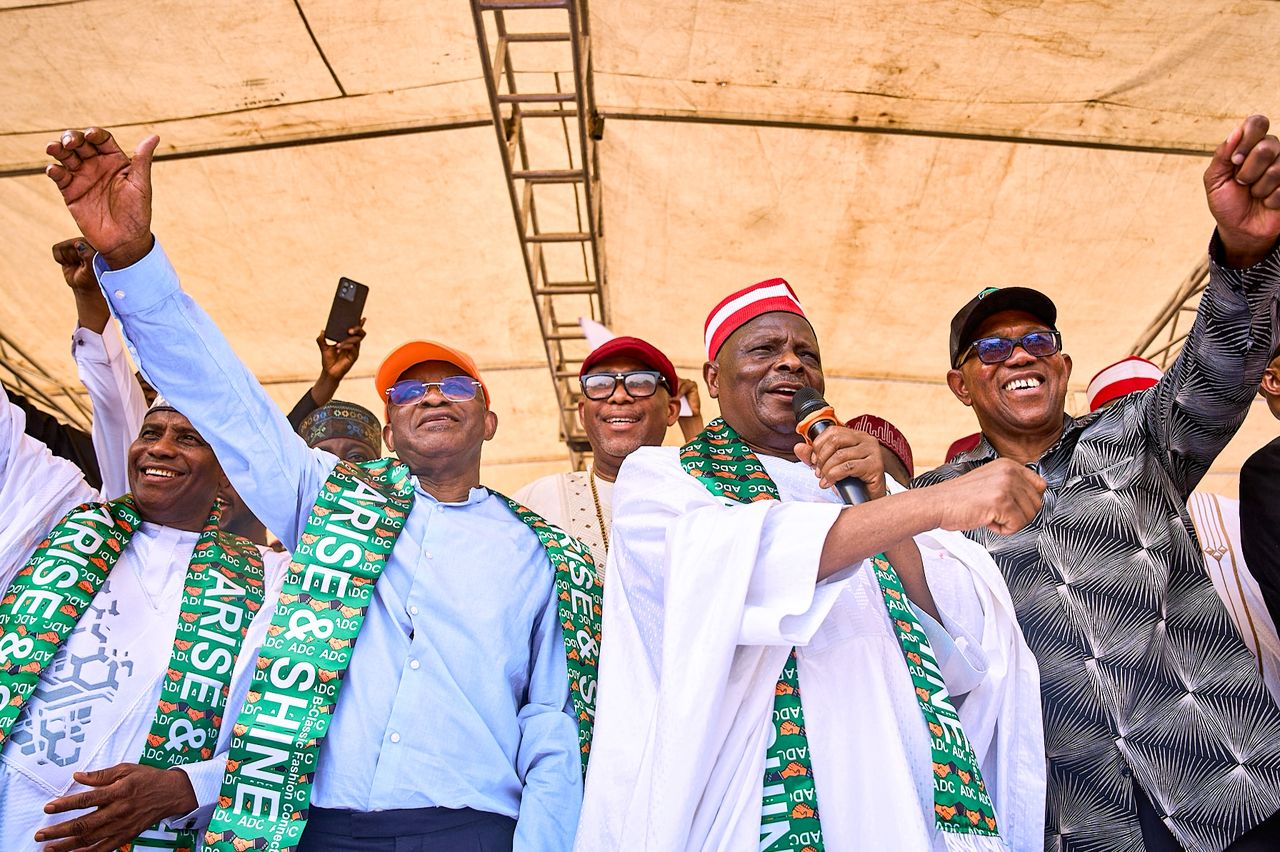
Former Kano State Governor and leader of the Kwankwasiyya Movement, Rabiu Kwankwaso, has revealed that northern political leaders carefully assessed possible allies before deciding to align with Peter Obi ahead of the 2027 presidential election.
Speaking during an interview on Arise TV on Monday, Kwankwaso dismissed suggestions that there is a hidden rivalry between his political camp and Obi’s within the NDC coalition.
According to him, the alliance was built on trust, competence, and a shared goal of moving the country forward.
“I looked around together with our leadership in the north to ask ourselves who is capable and who can genuinely work with us to move the country forward. Along the line, we realised Peter Obi stood out, and that was why we agreed to work together,” he said.
Kwankwaso, who was the presidential candidate of the New Nigeria Peoples Party in the 2023 election, remains one of the most influential political figures in northern Nigeria through the Kwankwasiyya Movement, which commands a strong grassroots following, especially in Kano State and parts of the North.
He recently left the NNPP following internal disagreements and joined the NDC alongside Obi earlier this month.
Obi, a former governor of Anambra State and Labour Party presidential candidate in 2023, gained widespread support among youths and urban voters across Nigeria during the last election cycle.
Both politicians formally joined the NDC on May 3 after leaving the crisis-ridden African Democratic Congress.
At the party’s national convention in Abuja on Saturday, Kwankwaso backed the decision to zone the NDC’s 2027 presidential ticket to the South, describing it as a move that promotes fairness, unity, and national balance.
Addressing concerns about possible tension between himself and Obi, Kwankwaso said political conflicts between leaders and their deputies usually come from greed and unnecessary power struggles.
“The problem with many leaders is greed. There is so much work to do, so there is no reason to fight your deputy,” he said.
He pointed to his own political experience, saying he maintained stable working relationships throughout his years in office.
“I worked very well with my speaker when I was deputy speaker in the House of Representatives. Even in Kano, despite challenges, my deputy and I worked together for eight years, and I eventually handed over to him peacefully,” he explained.
Kwankwaso said the same principle applies at the national level, insisting that good leadership requires cooperation rather than rivalry.
Read Also:
MEDIA CREDIBILITY AT STAKE
He also linked the current alliance to Nigeria’s political history, recalling how northern and southeastern leaders previously worked together successfully.
According to him, alliances between the North and South-East date back to the First Republic under former Prime Minister Abubakar Tafawa Balewa and continued during the Second Republic under former President Shehu Shagari and his deputy, Alex Ekwueme.
“They are our friends. We want to work together with them,” he said.
Kwankwaso argued that Nigeria’s political power-sharing arrangements later shifted away from the South-East after the annulment of the June 12 election and the emergence of leaders from the South-West, including former President Olusegun Obasanjo and President Bola Ahmed Tinubu.
He stressed that Obi’s selection was based on capacity and not simply regional politics.
“It wasn’t just about going to the South-East for political balancing. We realised Peter Obi is at the forefront, and that’s why we agreed to work together,” he said.
The alliance between Kwankwaso and Obi has already started reshaping the opposition landscape ahead of 2027, with several lawmakers and political blocs reportedly moving toward the NDC.
Political observers believe the partnership combines Kwankwaso’s strong northern grassroots structure with Obi’s influence among young and urban voters, creating what could become one of the strongest opposition platforms against the ruling APC in the next general election.